Robot runner handily beats humans in half-marathon, setting new record
Chinese humanoid robots achieved a breakthrough by completing a half-marathon in 50 minutes autonomously, beating human world records and demonstrating rapid advancement in robotic mobility and AI-powered navigation. This milestone reflects the billions being invested by Chinese and US tech companies in humanoid robotics for industrial and workplace applications, though widespread commercial viability and ROI remain uncertain. The technology's maturation from 2-hour race times last year to sub-1-hour performance signals accelerating capability in autonomous systems that could impact warehouse operations, manufacturing, and other human-centric work environments.
Ars Technica2 min read
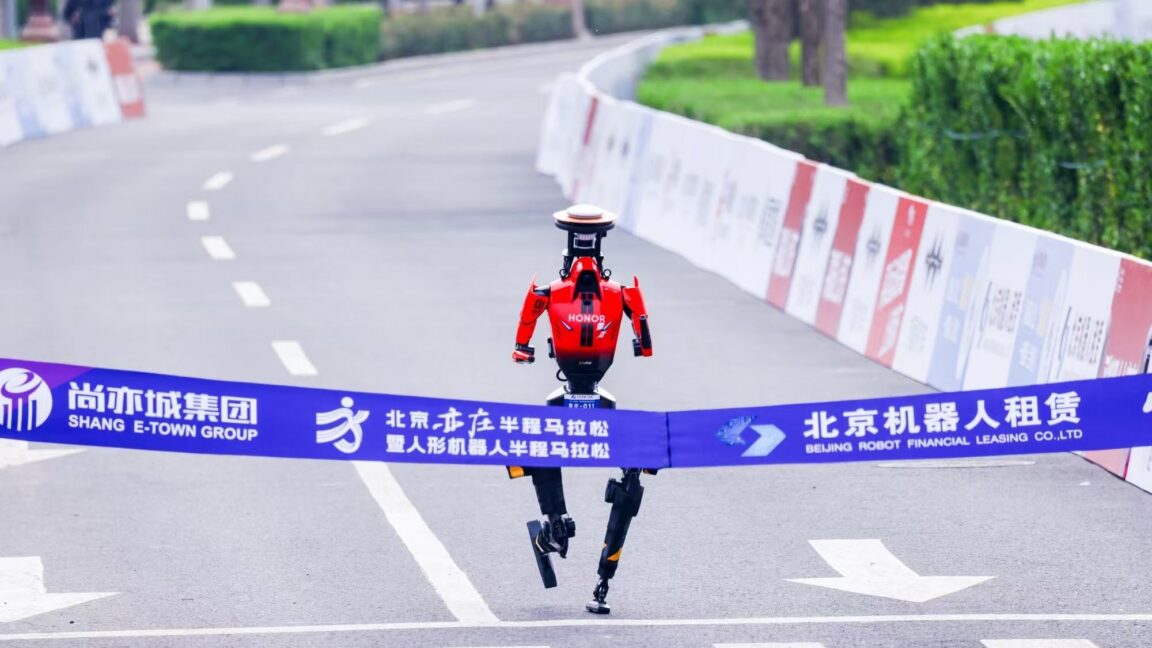
Humanoid robots outran the fastest human competitors while surpassing the human world record during a half-marathon event held in Beijing on April 19. The demonstration of fast-improving robotic speed and autonomy comes as China’s tech industry is rapidly scaling up mass production of humanoid robots to explore possible uses in the real world. The fastest robot from Chinese smartphone-maker Honor notched a winning time of 50 minutes and 26 seconds while autonomously navigating the 13-mile (21-kilometer) route, according to the Global Times. That beat the human world record of 57 minutes and 20 seconds recently set by Ugandan long-distance runner Jacob Kiplimo during the Lisbon Half Marathon. The winning robot design took inspiration from top human athletes by incorporating long legs measuring approximately 37 inches (95 centimeters) in length, said Du Xiaodi, a test development engineer for Honor, who spoke as a member of the winning team to The Associated Press and other publications. Xiaodi also described the robot as incorporating a custom liquid-cooling system—derived from similar cooling technology for consumer electronics—that could potentially be adapted for industrial applications.Read full article Comments